
260,000 Puffins and They All Come Back to the Same Island
Witless Bay Ecological Reserve in Newfoundland holds over 260,000 breeding pairs of Atlantic puffins, the largest colony in North America. The Atlantic puffin is Newfoundland and Labrador's provincial bird. They are monogamous, returning to the same mate and the same burrow every spring. The IUCN lists the Atlantic puffin as Vulnerable, with populations declining across most of its range due to climate-driven food shortages. They breed on islands from Newfoundland to Iceland to the British Isles, then disappear to the open Atlantic for eight months, largely invisible to the world.
Every spring, something happens off the east coast of Newfoundland that is easy to understate. A small black-and-white bird, one that has spent the last eight months alone on the open Atlantic, turns towards land. Not just any land. The specific island where it was born. The same burrow it dug or inherited. The same mate it left in August.
It does this every year. It has done it for decades. And at Witless Bay, about 30 kilometres south of St. John's, it does this in numbers that are genuinely hard to picture: over 260,000 breeding pairs return to this small cluster of islands each summer, making it the largest Atlantic puffin colony in North America.
The reserve was first designated a wildlife sanctuary in 1964. The birds were here long before that.
Major Atlantic Puffin Colonies
| Location | Breeding Pairs | Notable Fact |
|---|---|---|
| Vestmannaeyjar (Westman Islands), Iceland | 3-4 million (largest single colony) | Iceland holds roughly 60% of the world's Atlantic puffins (8-10 million birds total) |
| Faroe Islands | ~500,000 | Third largest population globally; long history of traditional puffin hunting |
| Witless Bay, Newfoundland, Canada | 260,000+ | Largest colony in North America; Newfoundland and Labrador's provincial bird |
| Farne Islands, Northumberland, UK | ~50,000 | Managed by the National Trust; one of the most accessible UK colonies by boat from Seahouses |
| Skomer Island, Pembrokeshire, Wales | ~40,000 | One of the largest UK colonies; accessible by day ferry from Martin's Haven |
| St. Kilda, Outer Hebrides, Scotland | ~150,000 | Remote UNESCO World Heritage Site; one of Scotland's most significant seabird stations |
The Return

Photo by Kevin Morgans
Photo by Kevin Morgans
Atlantic puffins are monogamous, and they are loyal to a degree that feels almost deliberate. They return to the same mate, the same burrow, the same stretch of cliff, season after season. A pair will raise a single chick each year, a puffling, in a burrow they dig into the soft earth of the headland. By late summer, the chick is ready and the family separates, each bird heading back out to sea alone.
Then April comes, and they find each other again.
The fidelity is not symbolic. It is a survival strategy that has refined itself over millions of years. A known mate, a known burrow, a known colony: these things reduce the cost of breeding and increase the odds for the chick. The puffin does not return because it is sentimental. It returns because returning works.
The Newfoundland and Labrador Provincial Bird is not the moose, not the osprey. It is the Atlantic puffin. A bird that spends most of its life invisible, far offshore, and then comes back to the same island every spring. There is something fitting about that for a province whose identity is built on the sea, on departure, and on the pull of returning home.
Witless Bay: What You Are Looking At
The four islands of Witless Bay Ecological Reserve are not accessible by foot. You reach them by boat tour out of Bay Bulls or Witless Bay, running from June through August. What you see when you arrive is difficult to describe calmly: the air above the islands is dense with birds. Puffins lined up on the cliff edge, puffins circling, puffins diving. The sound is low and constant, a colony in full operation.
Puffin season runs from April to August. The birds arrive in spring to claim their burrows and breed, raise their single chick through the summer, and are gone by late August. Outside of that window, the islands are empty. The birds are somewhere on the North Atlantic, and no one is entirely sure where.
That invisibility is part of what makes the return so striking. These are not birds that live near people or tolerate observation year-round. They surface once a year, briefly, to do the one thing that requires land.
Iceland: Where Most of the World's Puffins Live
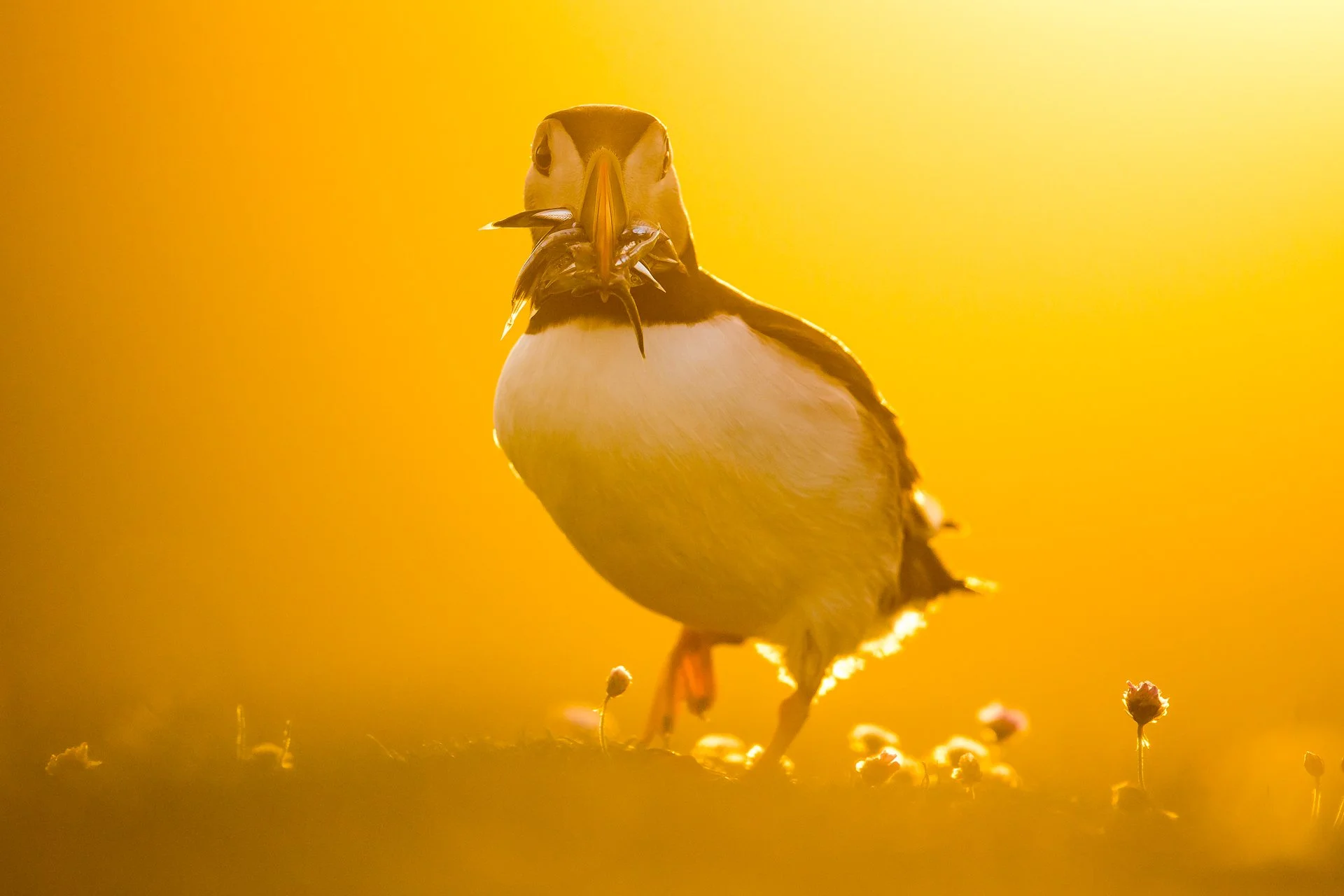
Photo by Kevin Morgans
Newfoundland holds the largest colony in North America. But to understand the scale of the Atlantic puffin globally, you have to go to Iceland.
Iceland holds approximately 60 percent of the world's Atlantic puffin population, somewhere between 8 and 10 million birds. The largest single colony is at Vestmannaeyjar, the Westman Islands, off the south coast. These are volcanic islands, young by geological standards, and the puffins have filled them completely.
The Westman Islands have a tradition called puffling patrol, where local children go out at night in late summer to collect young puffins that have become disoriented by the town's lights and bring them to the shore to release them safely. It is a practical response to a problem caused by human settlement, carried out with genuine care. The towns were built into puffin habitat, and the towns take some responsibility for that.
Iceland and Newfoundland together represent two ends of the same Atlantic. The puffins move between these waters, spending their winters somewhere in the space between.
The Faroe Islands: A Different Relationship
The Faroe Islands have approximately 500,000 breeding pairs of Atlantic puffins, the third largest population in the world. They also have a long history of hunting them.
Puffin hunting in the Faroes is traditional, carried out with a net on a long pole called a fleygastong, and it has been part of Faroese subsistence culture for centuries. The relationship is not casual. Faroese hunters know the birds closely, know the cliffs, know the patterns of the colony. But the populations have declined sharply in recent decades, and the debate about whether and how much to continue hunting has become more complicated as the numbers fall.
The Faroes sit at the intersection of old practice and new pressure. Climate change has reduced sand eel populations, the puffin's primary food source, across the North Atlantic. The birds are arriving at their colonies in worse condition, raising fewer chicks successfully. In the Faroes, in Iceland, in the UK, the trend lines are the same.
The British Colonies: Farne Islands, Skomer, St. Kilda
The UK has a scattered network of puffin colonies, most of them on offshore islands that have always been remote enough to stay wild. The Farne Islands off Northumberland, managed by the National Trust, are among the most visited, with around 50,000 breeding pairs. Skomer Island in Pembrokeshire, Wales, holds one of the largest UK colonies and is accessible by day ferry from Martin's Haven. The Scottish islands, Handa in Sutherland, St. Kilda in the Outer Hebrides, hold smaller but significant populations.
UK colonies have been under pressure for years. Sand eels, which puffins rely on to feed their chicks, have shifted north as sea temperatures rise. Adult birds return to the colonies but struggle to bring enough food back to the burrow. Chick survival rates have fallen. Some colonies that were stable for decades are now declining.
The birds keep coming back to the same cliffs. The cliffs have not changed. What has changed is the sea between them and their food.
What the Return Means
There is a version of this story that is purely biological: puffins return because natal philopatry is an effective reproductive strategy, because familiarity with a site and a mate reduces breeding costs, because the colony provides safety in numbers. All of that is true.
There is also something else in it. A creature that spends eight months alone on the open ocean, covering thousands of miles, in weather that would ground any small plane, and then finds its way back to the same few square metres of cliff. Not approximately. Exactly.
The Atlantic puffin's range covers the whole North Atlantic coastline. Newfoundland. Greenland. Iceland. The Faroes. The Scottish islands. Wales. The coasts of Norway, Ireland, Brittany. Every one of those coastlines has its own history, its own people, its own relationship with the sea. The puffin connects them without knowing it does.
If you want to read more about why this bird matters beyond its range, the AukCliff blog on Atlantic puffin conservation and clothing covers the connection between what we wear and what we protect.
The Captain Puffin Heritage collection at AukCliff started with that idea: the coastlines where puffins actually live, rendered as designs that carry something of where they come from. The Newfoundland and Labrador design, the Faroe Islands Fisherman, the Iceland Wanderer, the Scottish Heritage, the Welsh Heritage, the British Explorer. Each one a coastline. Each one a place where, every April, the birds come back. The collection was built by Stephen Milner, founder of AukCliff, to connect people with these places and the birds that tie them together.
Some things are worth returning to.
Frequently Asked Questions
Where is the largest Atlantic puffin colony in North America?
The largest Atlantic puffin colony in North America is at Witless Bay Ecological Reserve in Newfoundland, Canada, approximately 30 kilometres south of St. John's. Over 260,000 breeding pairs nest on the four islands of the reserve each summer, from roughly April through August.
When is puffin season in Newfoundland?
Puffin season in Newfoundland runs from April to August. The birds arrive in spring to claim their burrows and raise a single chick, then depart by late August. Boat tours from Bay Bulls and Witless Bay typically operate June through August, giving the best viewing of active colonies.
Where do Atlantic puffins go in winter?
Atlantic puffins spend the winter far out on the open North Atlantic Ocean, far from any coast. They are highly pelagic during this period, meaning they live entirely at sea, and their exact winter distributions are still being mapped through tracking studies. They surface for land only during the breeding season.
Which country has the most Atlantic puffins?
Iceland holds approximately 60 percent of the world's Atlantic puffin population, estimated at between 8 and 10 million birds. The largest single colony is at Vestmannaeyjar (the Westman Islands) off Iceland's south coast. Iceland and the Faroe Islands together hold the majority of the global population.
Do puffins mate for life?
Atlantic puffins are monogamous and typically return to the same mate year after year. They also return to the same burrow on the same stretch of cliff each breeding season. Pair bonds can last many years, though they separate completely during the winter months at sea and reunite at the colony each spring.
Are Atlantic puffin populations declining?
Yes. The IUCN currently lists the Atlantic puffin as Vulnerable, having upgraded its status from Least Concern in 2015. The main driver is a decline in sand eel availability caused by rising sea temperatures, which reduces breeding success across Iceland, the Faroes, and the British Isles. Some colonies are stable, but the global trend is downward.
Explore the Captain Puffin Heritage collection.
Last updated: April 2026
Wear it out there

Simple
$75.99
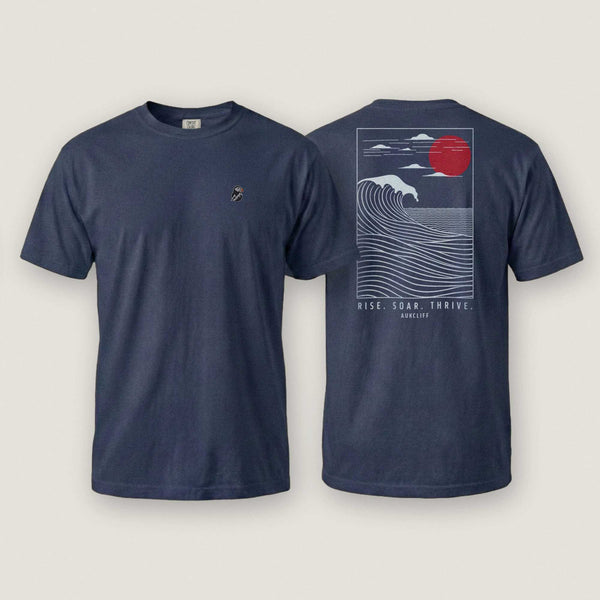
Coastal Waves
$101.99
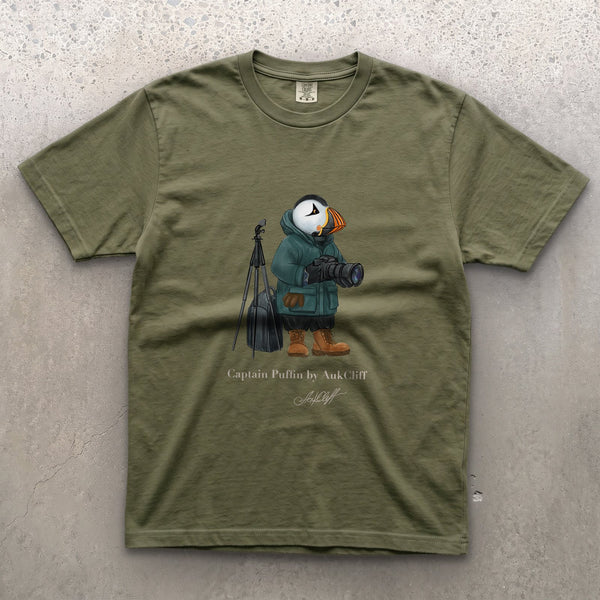
Captain Puffin Wildlife Photographer
$84.99
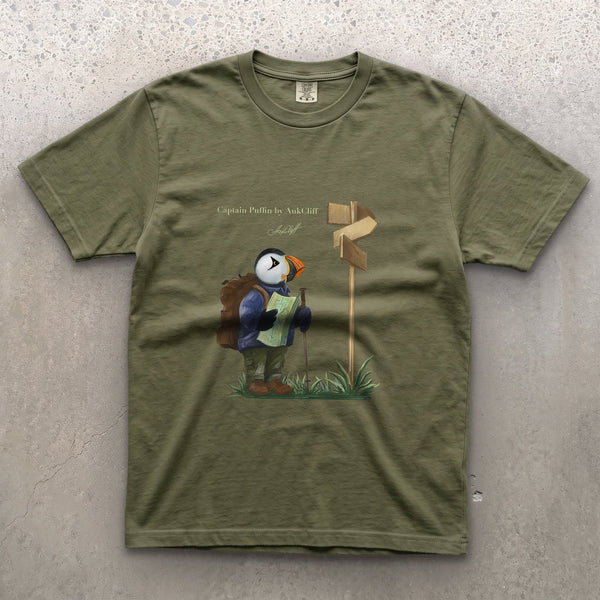
Captain Puffin Hiker
$84.99
Get the next one
New designs as they land, and the stories behind them. Unsubscribe in one click.