

Best Hiking and Trail Apps 2026: GPS, Tracking, and Navigation
Your phone is now one of the most useful pieces of kit you can carry on the trail. The right app can mean the difference between confidently navigating a remote ridge and standing at a junction in the rain, spinning your paper map. With the hiking apps market valued at $1.2 billion in 2024 and projected to reach $2.5 billion by 2033 (Verified Market Reports), the space has exploded with options. Here is a clear breakdown of what is worth downloading in 2026.
AllTrails: The Crowd Favourite for Good Reason
AllTrails has built the largest trail community in the world. With 55 million registered users and over 450,000 curated trails across the globe (Growth Loop Teardown), it is the obvious starting point for most hikers. The free tier gives you access to trail listings, reviews, photos, and basic GPS tracking. Pay for AllTrails+ (around $36 USD per year) and you unlock offline maps, turn-by-turn navigation, weather overlays, and the ability to print maps.
The community data is genuinely valuable. Recent photos and "trail conditions" updates from other hikers tell you whether the track is muddy, whether the waterfall is flowing, or whether the summit route is blocked by snow. No other app has matched this at scale. AllTrails reaches 45 million people per year (AllTrails Official), and that community density shows up directly in the quality of recent trail updates.
Best for: day hikers, weekend trips, finding new trails in unfamiliar areas.
Komoot: Built for Route Planning and Adventure Travel
Komoot takes a different approach. Rather than a trail database, it is a route planning tool built around cycling and hiking. You pick a start and end point, select your sport profile (hiking, mountain biking, gravel cycling), and Komoot generates a route using OpenStreetMap data and its own trail surface analysis. The turn-by-turn voice navigation is excellent, and the offline maps work reliably.

Komoot sells maps by region, so you pay once for the areas you hike regularly and own them permanently. For travellers who visit multiple countries, the pricing can add up, but the route quality in well-mapped regions like the Alps, Pyrenees, and Scandinavia is hard to beat. If you are planning a multi-day route rather than following a named trail, Komoot is the strongest planning tool available.
Best for: route planning, multi-day hikes, European travel, mountain biking crossover.
Gaia GPS: The Choice for Serious Backcountry Navigation
Gaia GPS is the standard for backcountry hikers, hunters, and search-and-rescue teams in North America. It supports a wide library of map layers, including USGS topo maps, satellite imagery, weather overlays, and snow depth maps. You can overlay multiple layers simultaneously, which is genuinely useful when you need to cross-reference trail lines with terrain contours and recent snow coverage.
The GPS accuracy is strong, and the app handles large offline map downloads well. The interface is more technical than AllTrails, which is the point. If you are navigating cross-country or in areas with minimal trail marking, Gaia gives you the map tools to do it properly. The premium plan is around $40 USD per year and unlocks the full map library.
Best for: backcountry hiking, cross-country navigation, technical terrain, thru-hiking in North America.
OS Maps: Essential for Hiking in Britain
If you hike in England, Scotland, or Wales, Ordnance Survey maps are the gold standard. The OS Maps app puts the full 1:25,000 and 1:50,000 map series on your phone, with GPS tracking, route recording, and offline downloads. The detail on OS 1:25,000 maps is exceptional: field boundaries, footpaths, bridleways, and access land are all marked with precision that no international app can replicate for UK terrain.
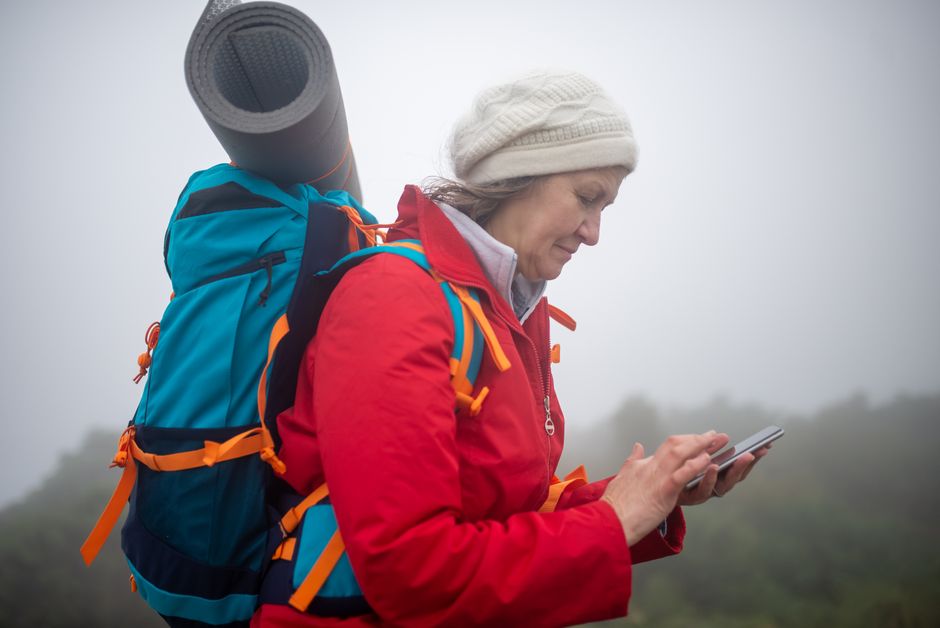
Photo by Kampus Production via Pexels
The subscription runs around £4 per month and is genuinely worth it for anyone hiking the UK regularly. For international visitors, a short-term plan makes sense for a trip to the Lake District or the Scottish Highlands. No other app comes close for navigating the UK's dense network of rights of way.
Best for: hiking anywhere in England, Scotland, or Wales.
Strava (formerly FatMap): Trail Running and 3D Terrain
FatMap was acquired by Strava in 2023 and its 3D terrain mapping capability has been folded into the broader Strava platform. For trail runners, Strava remains the dominant social and tracking layer, with segment leaderboards, training load analysis, and route discovery built around the running community.
The 3D terrain view, inherited from FatMap, is useful for visualising technical mountain terrain before you set out. For trail runners who want to track performance, log routes, and connect with a running community, Strava is the natural home. Pure hikers will likely find AllTrails or Gaia more practical for navigation, but if trail running is your primary activity, Strava's ecosystem is hard to leave.
Best for: trail running, performance tracking, segment-based motivation.
Free vs Paid: What Actually Matters
The single most important paid feature across every app is offline maps. Mobile signal is unreliable in mountains, gorges, and dense forest. Downloading a region before you leave means the app works regardless of connectivity. Every app listed above gates offline maps behind a paid tier, and it is worth paying for on any app you rely on.

Photo by Francesco Paggiaro via Pexels
Beyond offline maps, the value of paid tiers depends on how you use the app. Turn-by-turn voice navigation is useful on long multi-day routes where you want to keep your phone pocketed. Weather overlays are genuinely useful for alpine planning. Social and community features like AllTrails' trail condition reports are built into the free tier and represent some of the most practically useful data any of these apps provide.
For casual day hikers, the free version of AllTrails plus downloaded offline areas (which require a paid plan) is a practical and affordable setup. For backcountry users, Gaia GPS Premium is the right call.
Protecting Your Phone Battery on the Trail
GPS tracking is one of the heaviest drains on a phone battery. A full day of active GPS logging can drain most phones in 5-6 hours. A few practical habits make a real difference:
- Download offline maps before you leave home, so the app is not pulling data over a network connection throughout the day.
- Enable battery saver or low-power mode on your phone, which reduces background app activity without affecting GPS accuracy.
- Turn off the screen between navigation checks. The display is the second biggest battery drain after GPS.
- Carry a small power bank. A 10,000 mAh bank adds two to three full charges and fits in a hip belt pocket.
- Keep your phone warm in cold conditions. Battery capacity drops significantly below 10 degrees Celsius.
If you are planning a multi-day thru-hike, consider a dedicated GPS device for navigation and reserve your phone for photos and communication. The Garmin inReach Mini pairs well with any of the apps above and adds satellite messaging for emergencies.
Which App Should You Actually Use?
The honest answer is: it depends on where you hike and what you need from the app.
Start with AllTrails if you want the largest trail database and community conditions data for day hikes. Add Gaia GPS if you spend time in remote backcountry. Use OS Maps if you hike in Britain. Use Komoot if you plan multi-day routes or mix hiking with cycling. Use Strava if trail running is your primary sport.
Most serious hikers end up running two apps: one for trail discovery and community data (AllTrails), and one for precision navigation in remote terrain (Gaia GPS). The overlap in cost is modest and the two tools genuinely complement each other.
Before your next adventure, pair the right app with the right kit. AukCliff's Captain Puffin Hiker T-Shirt features hand-drawn artwork by artist Maria, designed in New Zealand for people who actually get out on the trail. The Embrace The Mountain Call Tee and Simple Comfort Colors T-Shirt are made from premium Comfort Colors cotton, soft enough for a long day pack-out. Top it off with the Organic Trailblazer Dad Hat for sun protection on exposed ridges. Browse the full outdoor T-shirts collection for more trail-ready gear.
Frequently Asked Questions
Is AllTrails free to use?
AllTrails has a free tier that includes access to trail listings, user reviews, photos, and basic GPS tracking. The paid AllTrails+ subscription (around $36 USD per year) unlocks offline maps, turn-by-turn navigation, weather overlays, and printed maps. For most day hikers, the paid tier is worth it for offline maps alone.
Which hiking app works best without phone signal?
All the major apps support offline maps with a paid subscription, but Gaia GPS is widely considered the strongest for offline use in remote terrain. It supports large offline map downloads across multiple map layers and handles areas with no signal well. Download your maps at home before heading out, regardless of which app you use.
What is the best hiking app for international travel?
AllTrails has the broadest international trail database and is the most practical choice for finding trails in new countries. Komoot is strong for European routes, particularly if you are planning custom itineraries rather than following named trails. For specific countries, dedicated apps (like OS Maps in the UK) will outperform international platforms.
How accurate is phone GPS for hiking?
Modern smartphones use multi-constellation GPS (combining US GPS, European Galileo, and Russian GLONASS satellites) and are accurate to within 3-5 metres in open terrain. Accuracy degrades in dense forest, deep gorges, and urban canyons where satellite signals are obstructed. For most hiking, phone GPS is more than accurate enough. Dedicated GPS devices like Garmin units are more reliable in extreme conditions and offer longer battery life.
Can I use hiking apps on a smartwatch?
Yes. AllTrails launched a Wear OS app that gained over one million downloads in its first period of availability (Android Developers Blog), and the app is also available on Apple Watch. Komoot and Strava both support Apple Watch and Wear OS. Watching a trail map on your wrist is useful for keeping your phone pocketed, though the small screen limits detailed navigation. Most hikers use their watch for pacing and elapsed time and their phone for map checks.
You Might Also Like
Every AukCliff order plants a tree through our partnership with One Tree Planted.


