

Ridge hiking is a specific kind of experience. You're above the treeline, often both sides of the path drop away, the wind has nowhere to hide, and the views extend in every direction. There's a reason people who do it once come back to it again and again: the exposure sharpens everything.
This guide covers what ridge hiking actually involves, some of the best ridges in the world, how to prepare properly, and what to wear when you're up there.
What Ridge Hiking Is
Ridge hiking is walking along the spine of a mountain or hill range, typically at or above the treeline. The defining characteristic is exposure: you're on a narrow elevated path with significant drops on one or both sides, often in full wind and with limited shelter. This is different from trail hiking through valleys or forests, where the environment is more forgiving and navigation is more straightforward.
The appeal is the panoramic perspective. When you're in a valley, your view is limited by the walls around you. On a ridge, you can often see for dozens of kilometres in every direction. You can watch weather systems approaching from far away, which is useful and occasionally alarming. You can see where you've been and where you're going simultaneously. It changes how you understand the terrain.
The commitment is also different. On a ridge, there are often fewer bail-out options than on a valley trail. You need to think more carefully about when you start, how long sections take, and what the weather is doing.
Famous Ridges Worth Knowing
The Cuillin Ridge on the Isle of Skye in Scotland is among the most serious ridge routes in the UK. The full traverse is a technical mountaineering undertaking, but sections of it are accessible to experienced hikers with good mountain sense. The rock is gabbro, which grips well even when wet, and the views across the Hebrides are unlike anything else in Britain. In Wales, Crib Goch on the Snowdon Horseshoe sees more incidents per visitor than any other area on the Llanberis Mountain Rescue Team's patch, with rescuers responding to around 12 instances of people becoming crag-fast on the route each year. That number reflects the appeal of exposed ridges as much as the hazard: Crib Goch draws confident scramblers who have pushed to the edge of their experience level.

The Bernese Oberland ridges in Switzerland, particularly around the Schilthorn and the Harder Kulm area, offer ridge walking with extraordinary Alpine views. The trails are well-maintained but the elevation and weather demand respect. Chamonix provides access to some of the most dramatic ridge sections in the Alps, with the Aiguilles Rouges traverse giving a full day of exposed walking with Mont Blanc as the constant backdrop.
In New Zealand, the Tongariro Alpine Crossing crosses the ridge between Ngauruhoe and Tongariro, with steep scree and lava fields that require solid footing. The Richmond Ranges and the Tararua ridge system provide long multi-day ridge traverses that are serious even by international standards, with rapid weather changes and limited rescue access.
In the US, Colorado's Fourteeners include several classic ridge approaches. The Knife Edge on Mount Katahdin in Maine is a half-mile of narrow rocky ridge that is both one of the most spectacular and most attention-requiring hikes in the Northeast.
How to Prepare for a Ridge Route
Build fitness specifically for the demands of ridge hiking. The uphill approach to most ridges is sustained and steep. Your legs need to be capable of 600-1000 metres of ascent with a loaded pack before the technical section even begins. Stair climbing, incline treadmill work, and regular hill sessions with a weighted pack are the most direct preparation.
Navigation competence matters more on a ridge than on a marked valley trail. Ridges can be straightforward in clear conditions and confusing in cloud. Learn to use a map and compass properly, not just a phone GPS. Batteries fail; your ability to take a bearing should not.
Study the route in advance. Know where the technical sections are, where the weather can catch you, and what the descent looks like. Look up the route on multiple sources, including walking forums where people post recent conditions. A ridge that's a pleasant walk in July might be a serious undertaking in October.
Weather: The Critical Variable
Weather management is the skill that separates experienced ridge walkers from those who get into trouble. Ridges sit above protective terrain features, so conditions up there can be dramatically different from the valley. A 25km/h wind at the trailhead might be 60km/h sustained on the ridge. Temperature can drop 10 degrees or more with altitude gain.

Photo by Alex Ramon via Pexels
Check multiple forecasts the evening before and again the morning of. Mountain-specific forecasts like Mountain Forecast (mountain-forecast.com) give altitude-specific wind, temperature, and precipitation data that general weather apps don't provide. Learn to read the forecast for the summit elevation, not the nearest town.
Have a firm turnaround time and stick to it. Most ridge accidents involve people who pushed past reasonable conditions because the summit was close. A fixed time-based turnaround removes the psychological pressure to continue. If you haven't reached the high point by a certain time, you turn around regardless.
Gear for Ridge Hiking
Footwear is the first priority. You need boots with a stiff sole for edge work on rocky ridges and enough ankle support for the uneven terrain. Gore-Tex or equivalent waterproofing is worth having even on dry-forecast days, because ridges catch weather that doesn't show up in lowland forecasts.
Layering is critical. A base layer, a mid-layer, and a windproof shell cover most conditions. The mid-layer is where you control temperature: on the climb it stays in your pack, on the ridge it goes on immediately. A heavyweight fleece or a midlayer you can move well in is the right choice. The Peak Junkie Hoodie from AukCliff's Origin Collection is 9oz premium fleece that has the weight to actually cut the chill on an exposed ridge without being so thick it's awkward to climb in.
Poles are worth considering for exposed ridges. They help with balance on narrow sections, take load off the knees on descent, and give you a third and fourth contact point when the wind is pushing you around. Don't underestimate how much fatigue a long descent adds to technical footing.
Clothing on the Ridge
Wind chill on an exposed ridge is more significant than most people expect. A 15-degree day in the valley can feel like a 5-degree day on the ridge with wind, and your sweat from the climb makes the cold bite harder. The transition from climbing to standing still at the top needs to happen fast: layers on immediately.
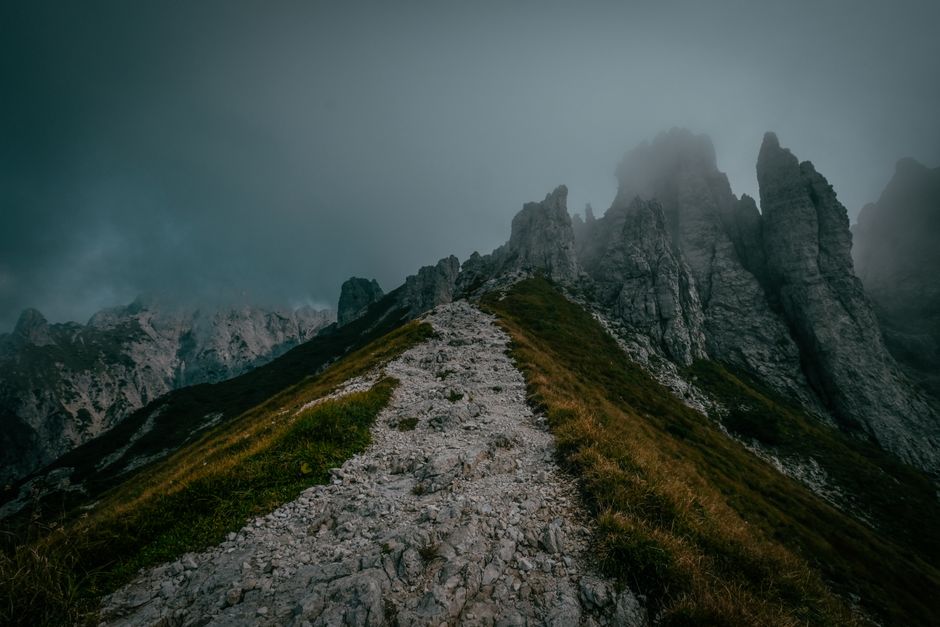
Photo by Francesco Ungaro via Pexels
For base layers and casual wear at camp or on approach days, the Raised on Peaks T-Shirt and the Life on the Edge T-Shirt are made on the heavyweight premium, which holds warmth better than lighter cotton and handles repeated use well. These work on drive-in days, at camp, and in hut accommodation.
For the colder months or high-altitude approaches, the Born of the North Hoodie layers well under a shell and has enough weight to stand alone when the wind drops. The full outdoor t-shirt collection is designed for people who spend real time in the field, not people who want to look like they might.
The Mindset for Exposed Terrain
Ridges demand a particular mental approach. Commitment is necessary: you decided to do this route, and the time to reconsider was before you started the approach. But commitment can't cross into stubbornness. The mountain will be there next month. A bad decision on an exposed ridge in deteriorating conditions carries real consequences. The Lake District Search and Mountain Rescue Association received 418 emergency calls in just the first seven months of 2024, a record for the region, with three fatalities on Helvellyn that year including routes via Striding Edge. Sharp Edge on Blencathra has recorded over 100 incidents and 11 fatalities since 1961, according to UK Hillwalking. These are not arguments against going into the hills; they are arguments for doing it with your head fully in the game.
Pay attention to your group's state. The slowest and most tired person sets the pace. Hunger and dehydration impair judgement and fine motor control faster than most people realise. Eat and drink before you're hungry or thirsty. Ridge hiking is one of the outdoor pursuits where the physical margin between competent and in trouble can close quickly.
The reward for doing it properly is significant. A clear day on a good ridge, above the cloud with views to the horizon in every direction, is one of the more memorable experiences the outdoors offers. It's worth preparing for correctly.
FAQ
- What's the difference between ridge hiking and regular trail hiking?
- Ridge hiking involves walking along the spine of a mountain range, typically above the treeline, with exposure on both sides. The terrain is more demanding, navigation requires more attention, weather conditions are more extreme, and bail-out options are more limited than on a standard valley trail.
- What footwear do I need for ridge hiking?
- Stiff-soled boots with ankle support and waterproofing. Trail runners are fine for many hiking conditions but lack the edge support and ankle protection that rocky ridges require. Break in your boots before the trip.
- How do I check weather for ridge hiking?
- Use mountain-specific forecasts like mountain-forecast.com, which provide altitude-specific wind speed, temperature, and precipitation. Check the forecast for the ridge elevation, not the nearest town or base elevation.
- What should I wear on a ridge hike?
- Base layer, fleece or insulating mid-layer, and windproof shell. Layers go on immediately when you stop moving. The wind chill on an exposed ridge is significant, and getting cold happens fast when you stop climbing.
- Is ridge hiking dangerous?
- It carries real risks that valley hiking doesn't: exposure, rapid weather changes, limited shelter, and terrain that requires solid footing. With proper preparation, good navigation skills, weather awareness, and a conservative approach to turnaround decisions, the risks are manageable. Don't attempt a serious ridge without mountain experience.
Related Reading
Frequently Asked Questions
What makes ridge hiking different from regular trail hiking?
On a ridge hike you are typically above the treeline with exposure on both sides, strong wind, and unobstructed views in every direction. That open exposure changes the experience significantly compared to forested or valley trails.
What are some of the best ridge hikes in the world?
There are exceptional ridges across multiple continents, from the European Alps to ranges in the Americas and beyond. The best options depend on your experience level and how much exposure you are comfortable with.
How should I prepare for a ridge hike?
Preparation needs to account for rapidly changing weather, limited shelter, and sustained physical effort at elevation. Checking forecasts carefully and planning your turnaround time before you set out is essential.
What should I wear for ridge hiking?
Wind protection is the priority since ridges funnel and amplify wind even on otherwise calm days. Layering with a windproof outer shell, moisture-wicking base layers, and a warm mid-layer covers most conditions.
Is ridge hiking suitable for beginners?
Some ridge routes are accessible to fit beginners, but the exposure and weather variability mean you should build up to them. Starting on shorter, lower ridges with clear weather windows is the sensible approach.
Explore the Captain Puffin collection
Last updated: April 2026


