

Bouldering is climbing stripped to its essentials. No ropes, no harnesses, no belayers to manage. Just a climber, a boulder, and a problem to solve. Problems is the right word, too: bouldering routes are called "problems" because they are exactly that, a short sequence of moves you work out through trial, failure, and eventually success.
It is one of the most accessible forms of climbing. You can start at an indoor gym with no equipment of your own, no partner, and no prior experience. Most gyms have a dedicated bouldering area with coloured holds on walls that are typically under five metres tall, with thick foam pads covering the floor beneath. The barrier to entry is genuinely low, and the learning curve is steep enough to keep things interesting for years.
How Bouldering Differs from Other Climbing
Traditional climbing and sport climbing involve ropes, anchors, and managing fall distances of tens of metres. Bouldering reduces the height to something manageable without protection, usually three to five metres, and removes the rope system entirely. The falls are shorter and land on pads (either gym matting or crash pads you carry outdoors), so safety comes from padding and technique rather than protection hardware.
This simplicity changes the character of the activity. Bouldering problems tend to be shorter and harder than roped routes, often requiring powerful single moves or short sequences of technically demanding moves rather than sustained endurance over a long route. It rewards strength, flexibility, and problem-solving more than cardiovascular fitness, at least in the early stages.
Understanding the Grading Systems
Two grading systems dominate bouldering worldwide.

The V-scale (Hueco scale), developed by climber John Sherman at Hueco Tanks in Texas, runs from V0 (beginner) up through V17 (elite). Most gyms use the V-scale in North America. V0 to V2 is accessible to most newcomers within their first few sessions. V4 to V6 represents a solid intermediate level that many regular boulderers spend years developing toward. V10 and above is serious athletic territory.
The Fontainebleau scale, used across Europe and widely at outdoor crags globally, runs from 3 up to 9A. The forest of Fontainebleau south of Paris gave the system its name and remains one of the world's most important outdoor bouldering destinations. The two systems are roughly equivalent: V0 corresponds to around 4 or 5 in the Font scale, V4 to 6B/6B+.
At the gym, problems are often colour-coded by difficulty rather than marked with explicit grades. The gym's introductory session or website will tell you what colours correspond to which level.
What Gear Do You Actually Need
For your first sessions at an indoor gym, almost nothing. Most gyms rent climbing shoes by the day for a few dollars. Everything else you arrive in works fine.
Climbing shoes are the one piece of gear that genuinely matters. They fit much tighter than street shoes, the rubber sole grips climbing holds, and the downturned shape helps you stand on small footholds. Rental shoes are adequate for learning. Once you know you are committed to the sport, a beginner-to-intermediate pair in the $80 to $150 range is the right starting investment.
Chalk is the other essential. Magnesium carbonate chalk dries your hands and improves grip on holds. A chalk bag clipped to your shorts, or a chalk bucket left on the pad near your problem, is standard gym kit. Most gyms also stock chalk balls (chalk contained in a mesh pouch to reduce dust).
What you wear should allow full range of motion. Stretchy shorts or pants, and a shirt that does not restrict shoulder movement. The Life on the Edge T-Shirt works well here, the 6.1oz garment-dyed cotton has enough natural stretch for climbing movement and looks like a normal shirt rather than technical gear. A lot of boulderers prefer cotton to synthetic for gym sessions because it breathes better and does not hold odour the same way.
Indoor vs Outdoor Bouldering
Indoor and outdoor bouldering are different sports with overlapping skills. Indoor gyms set problems on plastic holds attached to plywood walls. The holds are designed, the angles are engineered, and the problems are reset every few months to keep things fresh. It is consistent, accessible, and great for building technique quickly.
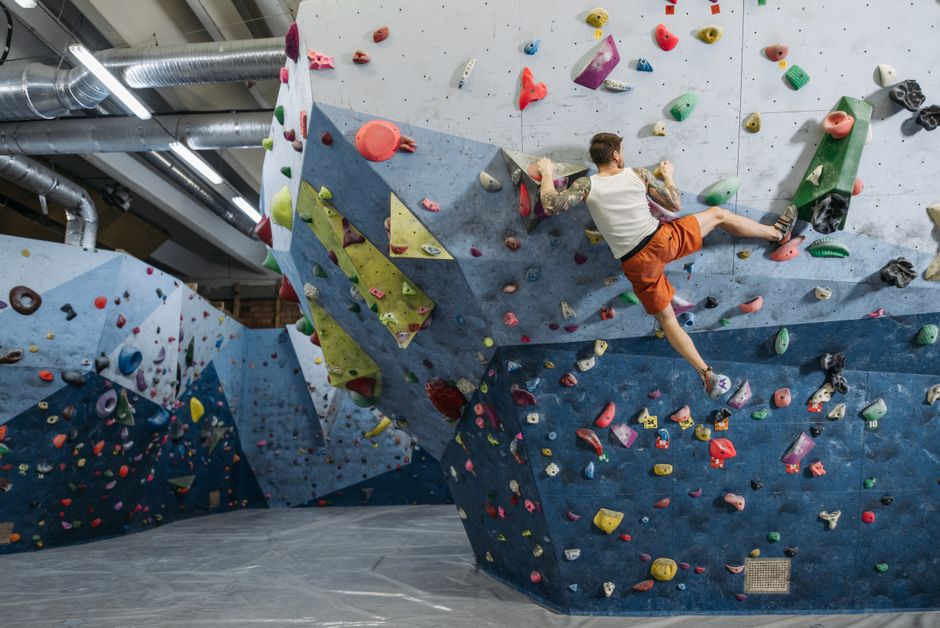
Photo by Pavel Danilyuk via Pexels
Outdoor bouldering is on natural rock, granite, sandstone, limestone, quartzite, and dozens of other types depending on where you are. The holds are not placed, they are found. Rock texture varies enormously and changes how you grip. Problems are permanent, famous ones having been climbed for decades. Weather matters. Friction improves in cold, dry conditions and drops sharply when it is humid.
Classic outdoor areas include Fontainebleau in France, Magic Wood in Switzerland, Hueco Tanks in Texas, Bishop in California, and the Grampians in Australia. Getting outdoors requires crash pads (thick foam pads you hike out to the boulder, typically 60 to 90 litres of foam weighing 10 to 15 kg), but the experience of climbing on natural rock is worth the extra logistics.
The climbing community has grown substantially to support all of this. According to the International Climbing and Mountaineering Federation, there are over 3,700 climbing gyms globally serving approximately 10 million participants. In the US alone, Statista reports 6.36 million indoor climbing participants in 2023, with North American gym counts above 870 facilities and growing at 4.7% annually according to Climbing Business Journal.
Safety and Fall Technique
Bouldering is notably safe by sports standards. A study published by the Wilderness Medicine Society found an injury rate of just 0.01 to 0.03 per 1,000 hours of climbing, which is lower than most recreational sports. That said, falls are frequent by design, and learning to fall correctly matters.
The instinct to reach out and catch yourself with your hands is the biggest risk in bouldering. A bent wrist catching your body weight from two or three metres is how wrists and collarbones get broken. Good fall technique involves landing on your feet, bending your knees to absorb impact, and rolling back onto your upper back and shoulders to distribute the force. Gym mats handle most of this naturally.
At indoor gyms, the foam pad floors are designed to absorb falls from the heights involved. Outdoor sessions require positioning crash pads carefully under the problem and having a spotter, someone who guides a falling climber onto the pads and protects their head and back rather than catching their weight. Learn spotting technique before you go outdoors.
Getting Started: Your First Month
Go to a gym. Most offer introductory sessions that cover the basics of movement, fall technique, and gym etiquette in under an hour. Book one or just show up and ask for the orientation.

Photo by Quang Nguyen Vinh via Pexels
For your first few sessions, focus entirely on the easiest problems. V0 and V1 at most gyms will feel trivially easy on some moves and surprisingly hard on others. That variation is the point. You are building vocabulary: how to use different hold types, how body position affects balance, how your feet matter as much as your hands.
The Raised on Peaks T-Shirt has become something of a gym regular in outdoor communities, the hand-drawn artwork by Maria catches attention from the kind of people who also spend weekends on rock. There is a social element to bouldering that accelerates learning. Other boulderers will offer beta (advice on how to do a move), share problems, and welcome questions from newcomers more readily than in most sports.
Once you have a handful of sessions, consider buying climbing shoes. Keep renting until then. Your technique will change quickly in the first month and the shoes you think you want on day one are not necessarily the right choice after six weeks.
Building Strength and Technique
Bouldering builds very specific strength: finger tendons, pulling muscles (lats, biceps, forearms), core, and hip flexors. This takes time. Finger tendon strength in particular develops slowly, and overtraining in the first months is the most common cause of injury in new climbers.
Two to three sessions per week with rest days between is a sensible starting schedule. Warm up properly on easy problems before attempting anything hard. Stretch after sessions, particularly hip flexors, hamstrings, and shoulders. Progress will feel slow at first, then rapid around months two to four as your body adapts and your technique catches up with your fitness.
The Peak Junkie Hoodie earns its place in the post-session bag. Nine-ounce premium fleece, warm enough for a cool gym lobby or a cold car park after an outdoor session. Bouldering outdoors in autumn and winter means warming up in layers and peeling them as you get moving. A quality hoodie is the standard layering piece.
Explore the full T-shirt range and The Origin Collection for more pieces built for active outdoor use.
Frequently Asked Questions
Do I need a partner to go bouldering?
No. Unlike roped climbing, which requires a belayer, bouldering is a solo activity by design. Indoor gyms are full of people climbing alone. Outdoor sessions are safer with a partner to spot, but experienced boulderers go solo outdoors regularly with careful pad placement. Starting at a gym solo is completely normal.
How long does it take to get good at bouldering?
Most people can solve beginner problems (V0 to V2) within their first few sessions. Reaching a solid intermediate level (V5 to V7) typically takes one to three years of consistent training, depending on your natural aptitude and how often you climb. The V scale is not linear: each grade gets progressively harder to achieve than the one before it.
What is the difference between bouldering and free climbing?
Free climbing means climbing using only your hands and feet on the rock, with ropes and gear used only for protection in case of a fall, not for upward progress. Bouldering is a form of free climbing, specifically the short, ropeless variant. "Free soloing" is climbing long routes without any rope at all, which is extremely dangerous and practiced by very few climbers.
Is bouldering safe for children?
Yes, and climbing gyms frequently offer youth programs. Children tend to learn movement quickly because they are lighter relative to their grip strength and naturally flexible. Most gyms have age minimums (often 5 to 7 years old) for safety reasons. The low heights and padded floors make indoor bouldering one of the safer activities for children interested in climbing.
Can I boulder if I have no upper body strength?
Yes. Technique matters far more than raw strength, especially in the early stages. Many beginners assume they need to train in a gym before starting climbing, which is backwards. Climbing builds the specific strength you need for climbing. Start at the gym, work easy problems with a focus on footwork and body position, and the strength will come from the climbing itself.


