
Wildlife Photographer Clothing: What to Wear in the Field
Wildlife photography is one of the most demanding outdoor pursuits for clothing. You are typically stationary for long periods, often before dawn or after dusk when temperatures drop, in terrain that ranges from saltwater margins to mountain forest. Your clothing cannot rustle when you shift your weight. It cannot be bright enough to catch an animal's eye. It has to manage sweat from the walk in and cold from the wait.
The scale of wildlife watching as an activity makes the clothing question worth taking seriously. According to the US Fish and Wildlife Service, 148 million US residents participated in wildlife watching in 2022, representing 57 percent of the American population. Those participants spent over $250 billion in 2022, including $118.6 billion on equipment. The global wildlife tourism market was estimated at $174.7 billion in 2024, projected to reach $263.6 billion by 2030 (Grand View Research), and birdwatching tourism specifically was valued at $67.4 billion in 2024 (Custom Market Insights).
Wildlife photography sits at the serious end of that spectrum. This guide is for people who are actually in the field, not browsing a wildlife park from a vehicle.
The Fabric Noise Problem
This is the issue that separates wildlife clothing from general outdoor gear, and it is the first thing to address. Nylon-shell jackets and hard-shell materials produce a swishing sound with every movement. In a blind or a hide, or when you are crawling through brush to close distance on a subject, that noise announces you before you arrive.
The solution is soft-shell materials and fleece for outer layers, and cotton or merino for mid-layers. Cotton has obvious limitations for active hiking (it holds moisture and loses insulation when wet), but for static photography work in temperate conditions, a heavy cotton layer is genuinely quieter than most technical fabrics.
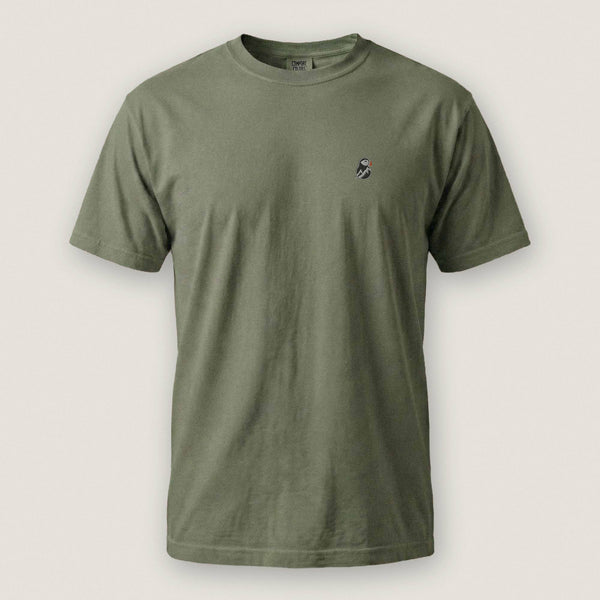
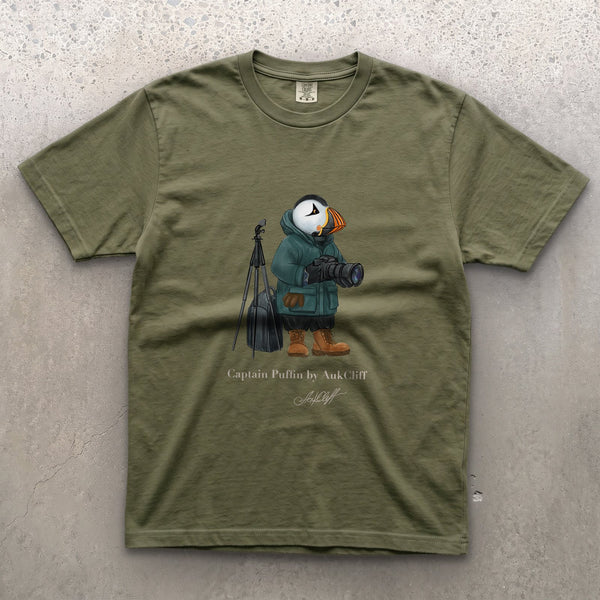
The 6.1oz heavyweight cotton in the Captain Puffin Wildlife Photographer T-Shirt works as a mid-layer for exactly this reason. The dense cotton is near-silent when you shift position, and the garment-dyed finish means the colour is not going to reflect light or catch attention in the field. The same construction applies to the Simple premium tees, which comes in the muted earth tones that work best for field work.
Colour Selection: The Practical Reality
Most wildlife photographers already know the basics here: avoid white, bright red, fluorescent anything. But the nuance is worth covering. Birds, particularly raptors and shorebirds, have excellent colour vision, and some see into the UV spectrum. Mammals navigate more by smell and movement than colour, though a white jacket against dark forest still matters.

The effective palette for most field work: olive, tan, brown, grey, and dark navy. These tones blend into most natural backgrounds without requiring full camouflage. Full camo has a specific use case (hunting, where concealment is the primary goal) but is overkill for most wildlife photography and can create awkward situations in public natural areas.
More important than pattern is tone. A medium-grey solid is less visible to most animals than a bright green camo pattern. Choose clothing that sits in the mid-to-dark tonal range and you will cover most situations without needing specialist hunting gear.
The Captain Puffin Wildlife Photographer Sweatshirt comes in colourways that sit comfortably in the field-appropriate range. The 9oz premium M2580 fleece is also considerably quieter than any synthetic shell, which matters during long waits.
Layering for Dawn and Dusk Shoots
The golden hours for wildlife photography are the same hours when temperature drops most quickly. A summer morning that starts at 8 degrees can be 22 degrees by 10am. You need to manage that swing without making noise when you remove layers.
The practical system for most conditions:
Base layer: merino wool or lightweight synthetic. Merino is the better choice because it manages odour over multiple days in the field, which matters when you are downwind of shy animals. A long-sleeved merino base layer worn against the skin provides warmth, moisture management, and some odour control.
Mid-layer: heavyweight cotton or fleece. This is the layer that does most of the thermal work during a cold wait. It should be quiet, easy to put on and remove, and warm enough to keep you functional through an hour of stillness at dawn.
Outer layer: soft-shell jacket or a second fleece. Hard-shell is the last resort, used only when rain is genuinely expected and warmth is more important than silence. A soft-shell provides wind resistance and light water resistance without the noise penalty of a hard-shell.
The key discipline: add layers before you need them. Once you are shivering, you have already compromised your concentration and your ability to stay still. Arrive warm and shed layers as the day heats up rather than putting them on reactively.
What Not to Wear
A few specifics worth naming:

Photo by SenuScape via Pexels
Zip pulls that catch on things and clink are more disruptive than you expect. Tape them down or replace them with cord loops. The sound of a zip pull hitting a camera body at the wrong moment has cost people shots.
Velcro on sleeves and chest pockets creates noise and catches on vegetation. Snap closures or buttons are quieter. If your jacket has velcro pockets, keep them closed and move slowly when the fabric is tight against brush.
Watch bands and bracelet hardware. Metal-on-metal contact against a camera body or tripod leg creates sound. A fabric watch band or removing jewellery entirely is worth the habit.
White or reflective lens hoods catch light in the same way that bright clothing does. A lens hood wrap or matte finish for telephoto lenses is a genuine field modification, not an affectation.
Hats and Head Gear
A hat serves two purposes in wildlife photography: sun protection for long days in open terrain, and head concealment in hides or blinds where your silhouette is visible above cover.
For most field work, a structured mid-brim hat in a muted colour is the practical choice. The Organic Trailblazer Dad Hat sits in that category: structured enough to maintain its shape over a full day, in a profile that does not catch wind or obstruct peripheral vision when you are tracking a moving subject.
For cold conditions, a beanie in merino or fleece serves better than a hat with a brim. The priorities shift from sun protection to heat retention when you are static in cold weather.
Camera Gear Considerations That Affect Clothing Choices
The kit you carry affects what you wear. A long telephoto lens on a monopod means one arm is often extended and one shoulder carries more load, which affects where seams can create friction. A tripod means more stationary time and less body heat generation from movement.

Photo by Quang Nguyen Vinh via Pexels
Pocket placement matters more for photographers than for other outdoor users. Memory cards, filters, and spare batteries need to be accessible without requiring you to open a main bag compartment. Look for clothing with accessible hip-level pockets or chest pockets that open quietly.
For photographers who travel to reach locations, pack size matters. A 9oz sweatshirt compresses into a pack more efficiently than a similarly warm synthetic insulated jacket, and it does not crinkle or make noise when packed.
Field-Tested Clothing Choices for Common Environments
Wetlands and shorebird habitat: waterproof lower layers, quiet soft-shell upper. Waterproof gaiters or waders if you are working in water. Rubber-soled footwear that does not squeak on wet surfaces.
Forest and woodland: full quiet fabrics, muted greens and browns. A lightweight face net if insects are a problem. Avoid anything that catches on branches.
Open mountain and moorland: wind resistance is the priority alongside quiet. A soft-shell jacket over a heavy fleece mid-layer covers most conditions. Gloves that allow camera operation, usually a fingerless or convertible design.
Coastal cliff and seabird colonies: wind is the main challenge. Layers that can be added and removed without noise. UV protection for long bright days over water.
The Captain Puffin collection started with a wildlife photographer persona because that is a culture worth representing accurately. The clothing that works in the field is the same clothing the character wears, practical, muted, and built for long days of patient attention.
Frequently Asked Questions
Do I need specialist photography clothing or will general outdoor gear work?
General outdoor gear works for most wildlife photography with some modifications. The main things to assess are noise (avoid hard-shell fabrics for static work), colour (stick to muted earth tones), and practicality (accessible pockets, quiet closures). You do not need camouflage gear or specialist photography vests unless you are doing very specific work in controlled conditions like wildlife hides.
How important is scent control for wildlife photography?
It depends on the subject. For mammals with strong olfactory senses (deer, bears, foxes), approaching from downwind matters more than any clothing choice. For birds, which generally rely more on sight than smell, scent is less critical. The practical habit worth developing is awareness of wind direction before and during an approach, regardless of what you are wearing.
What is the best base layer material for long waits in cold conditions?
Merino wool is the consistent answer for cold, static work. It provides warmth relative to its weight, manages moisture when you do move between spots, and does not develop the sharp odour that synthetic base layers produce over multiple days in the field. For summer photography, a lightweight merino is also worth using over synthetic because of the odour management benefit when you are trying to stay downwind.
Should I wear gloves for photography in cold weather?
Yes, but the type matters. Thin liner gloves that allow full finger movement are better than thick insulated gloves that make dial and button operation clumsy. Convertible mitts with a flip-back finger section are a practical solution for very cold conditions. Some photographers use adhesive hand warmers in jacket pockets to keep hands warm between shots without wearing gloves at all.
How do I stop my clothing from creating condensation fog on a cold lens?
Condensation on a lens usually comes from temperature differential, not clothing. If you move from a warm car or hide to cold air, the lens will fog. The solution is to let the lens acclimatise to outdoor temperature before shooting, which takes 10 to 20 minutes depending on the differential. A lens warmer attached to the barrel prevents fogging during long sessions in the cold. Clothing does not directly cause this problem.
You Might Also Like
Wear it out there
Simple
$75.99
Coastal Waves
$101.99
Captain Puffin Wildlife Photographer
$84.99
Captain Puffin Hiker
$84.99
Get the next one
New designs as they land, and the stories behind them. Unsubscribe in one click.