
What Landscape Photographers Wear: The Layering System Behind the Magic Hour
Quick answer: Landscape photographers wear a brushed-cotton or wool mid-layer, merino base, and a quiet softshell or oiled cotton outer, sized to sit for 20 minutes to four hours at a tripod position. The whole system is built around colour-temperature peaks that last ten to fifteen minutes per side of the sun.
A landscape photographer can spend three hours driving in the dark, forty minutes walking from the car, and another hour and a half standing behind a tripod before the light arrives. When the colour finally lands on the ridge it lasts about eleven minutes. Their hands have to work, the tripod has to be locked, the filter has to be clean, and the photographer themselves has to be warm enough to make decisions. The clothing problem behind that morning is not a fashion problem. It is a stillness problem.
What landscape photographers wear is a different question from what hikers or wildlife photographers wear. A hiker generates heat by moving. A wildlife photographer can shift inside a hide. A landscape photographer plants a tripod, composes a frame, and then has to hold the same body position for an hour or more while the light evolves. The clothing system has to handle the approach hike, the long static wait, and the slow walk back. This is a field guide to what working landscape photographers actually wear, the trade-offs they make on weight, warmth and silence, and the brands that show up in the field more than any others.
What makes landscape photography clothing different from hiking kit?
Hikers stay warm by walking. Landscape photographers stop walking and then have to stay warm anyway. That single difference cascades into every clothing decision a working shooter makes.
The stillness problem
A tripod-locked composition demands a tripod-locked body. Once the camera is framed and the filter is in, the photographer has minutes of micro-adjustment ahead of them, not movement. Insulation needs to be calibrated for the static body temperature, not the body temperature at the end of the approach hike. Most landscape photographers run hotter on the way in and colder on the way back, which is the opposite of how hiking kit is sized.
The light-window problem
The usable light in a sunrise or sunset window is short. Galen Rowell, the American mountain landscape photographer whose work shaped the discipline, called it the magic hour but in practice the colour-temperature peak is closer to ten or fifteen minutes per side of the sun. His estate site at galenrowell.com still archives his thinking on light-window planning. The clothing has to let the photographer make decisions during those minutes. Cold hands cost frames. Wet sleeves cost filters. A jacket that crunches every time the photographer shifts weight ruins the stillness the composition demanded.
The approach-hike problem
Most usable landscape locations involve a walk in the dark. Sometimes thirty minutes. Sometimes three hours. The kit has to be carriable and the clothing has to handle the temperature swing between the walk in (warm, sweating) and the static wait (cold, exposed). Layering is not optional.
How long do landscape photographers actually stay in one position?
Working landscape and outdoor photographers report holding a single tripod position for anything from 20 minutes to four hours per location, depending on what they are after. Coastal long-exposure work runs short and frequent. Mountain ridge work runs long and patient. Astrophotography sessions can hold the same position for the full night.

The kit needs to handle the whole range. A pre-dawn sit on a Scottish ridge in late May and an evening session on a Pacific Northwest beach are not the same brief. Most photographers run a layered system rather than a single garment, swapping pieces in and out as the morning progresses.
What does a working landscape photographer's layering system look like?
A standard four-layer system that survives a UK, Pacific Northwest or alpine spring shoot:
- Base layer: merino long-sleeve, 200gsm. Warm wet, no smell after three back-to-back mornings, dries on the walk back.
- Mid layer: midweight brushed-cotton or cotton-poly sweatshirt, roughly 280-340gsm. This is the layer worn for the whole shoot day, the one the rucksack strap sits on for hours, and the layer photographs of photographers tend to be of. Comfortable enough for the long static wait, durable enough for repeated wear.
- Insulation: down or synthetic-fill puffy. Static-wait insulation, not approach-hike insulation. Goes on at the tripod, comes off for the walk back.
- Outer: waterproof shell. Hardshell for serious mountain work, softshell for milder conditions. Páramo Directional Clothing jackets show up disproportionately on serious landscape shooters because the pump-liner system keeps moisture moving outward through long static waits without the clamminess of a membrane.
Trousers follow the same logic: warm static trousers for the wait, lighter walking trousers for the approach. A spare pair in the pack is normal practice.
Which brands actually show up in the landscape photography field?
Landscape photographers tend to gravitate toward heritage outdoor brands with quiet branding and serious technical credentials. The names that recur on workshop attendee lists and behind-the-scenes shoot videos are below.
| Gear area | Brands that recur in the field | Why landscape photographers choose them |
|---|---|---|
| Camera bag | F-Stop Gear, Shimoda Designs, ThinkTank, Lowepro Pro Trekker | Internal camera unit (ICU) systems with hiking-pack carry. F-Stop and Shimoda dominate the mountain landscape niche specifically. |
| Waterproof shell | Páramo, Arc'teryx, Patagonia, Rab | Páramo for long static work in wet conditions. Arc'teryx for fast alpine. Patagonia for the run-and-gun shoots. |
| Insulation | Buffalo Systems, Patagonia DAS Parka, Rab Neutrino, Mountain Equipment Lightline | Buffalo Systems pile-and-pertex layers are a cult favourite among UK mountain landscape shooters specifically because they work wet, dry on the body, and never freeze stiff. |
| Mid layer | Fjällräven, Filson, Finisterre, midweight brushed sweatshirts | Heritage cotton and cotton-poly blends. Comfortable for the long wait, durable enough for years of pack-strap abrasion. |
| Tripod and head | Gitzo, Really Right Stuff, Manfrotto 055 | Not clothing, but the tripod choice drives the static-wait length, which drives the warmth requirement of the rest of the kit. |
The mid-layer choice is where the conversation tends to land. Most landscape photographers do not actually want a technical fleece for the layer that sits between base and shell. They want a sweatshirt. Specifically, a midweight brushed-cotton or cotton-poly sweatshirt that handles the rucksack strap, the four-hour wait, and the slow walk back. Shimoda Designs founders Ian Millar and Michael Mei have both been photographed in this exact mid-layer category in their behind-the-scenes shoots. F-Stop Gear ambassadors fall into the same pattern.

Weight versus warmth: the long approach hike trade-off
Landscape photographers carry more weight than almost any other outdoor user group. Two camera bodies, three lenses (often including a heavy wide-angle and a long telephoto), filter system, tripod and head, spare batteries, headtorch, water and food. Workshop tutors at The Mountaineers, the long-running US mountain education organisation, regularly cite pack weights of 12-18kg as standard for full-day mountain landscape shoots. The clothing system has to fit around that load.
The trade-off:
- Lighter kit means colder waits. Cutting the down jacket saves 600g but turns a four-hour ridge wait into a forty-minute one.
- Heavier kit means a slower walk-in. A full mountaineering layering system adds 1.5-2kg to the pack and slows the approach hike enough to miss the magic hour.
- The compromise most photographers settle on: walk-in layer that vents well, static-wait layer that packs small but warms fast, mid-layer that bridges both. The mid layer is the layer that does the most work and gets changed the least often. It has to be right.
For the photography-specific layering logic that crosses over from the stills field, our piece on what wildlife photographers actually wear in the field covers adjacent ground from the wildlife-stills perspective. Landscape photographers can borrow the static-wait layer rules and skip the camouflage-and-concealment ones.
Why AukCliff built a Landscape Photographer Captain Puffin
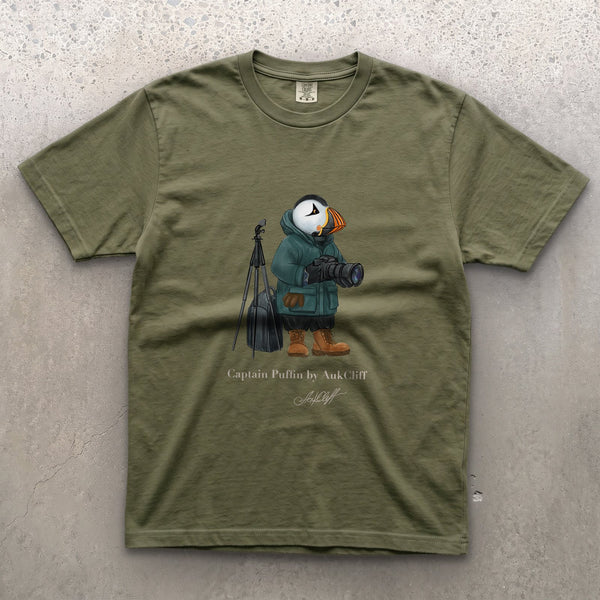
The Captain Puffin character series at AukCliff is hand-drawn, and each Captain represents a discipline within outdoor creator culture. The Landscape Photographer Captain Puffin T-shirt exists because the landscape niche is the most contemplative of the photography disciplines. One frame. No urgency. The moment is when the light is right, and the right light is something you can plan for but never actually order to appear.
The Landscape Photographer Captain Puffin Sweatshirt is printed on a midweight 80/20 cotton-poly fleece with a softly brushed interior, roughly 290gsm (Cotton Heritage M2480 blank). It sits inside the layering system above as the mid layer, the one the rucksack strap sits on for hours and the camera tends to find when the shooter has their back to the lens. It is the layer that gets worn the most and replaced the least often. The series was built around the observation that wildlife and landscape photographers tend to buy the same heritage mid-layer for the same reason: it works at rest.
For the story behind the puffin photography that anchors the whole Captain Puffin universe, our piece Behind the Lens: AukCliff Partners with Kevin Morgans covers the collaboration with the award-winning Atlantic puffin photographer whose work shaped the visual world this character lives in.
Frequently Asked Questions
What do landscape photographers wear for sunrise shoots?
A four-layer system works for most sunrise conditions: a 200gsm merino base layer, a midweight brushed-cotton or cotton-poly sweatshirt around 290gsm as the mid layer, a packable down or synthetic insulation jacket for the static wait at the tripod, and a waterproof shell for the walk in and walk out. The insulation jacket goes on at the tripod and comes off for the descent. Photographers who skip the insulation layer regret it within forty minutes of the camera being locked off.
Is a sweatshirt or a fleece better for landscape photography?
A midweight brushed-cotton or cotton-poly sweatshirt around 290gsm is the standard mid layer for long static landscape work because it is warm at rest, comfortable under a heavy rucksack strap, and durable enough for years of field use. Most technical fleeces are too thin to bridge the static-wait warmth requirement on their own and need a second insulation layer over them. The sweatshirt covers more of the temperature range with one garment.
Which brands do professional landscape photographers actually use?
Páramo Directional Clothing for waterproof shells in long static work, Arc'teryx for fast alpine shoots, Buffalo Systems for cold-and-wet UK mountain work, F-Stop Gear and Shimoda Designs for camera bags, Fjällräven and Filson for heritage mid layers, and Gitzo or Really Right Stuff for tripods. The mid layer category is where photographers reach for cotton and cotton-poly sweatshirts most often, because the layer has to survive a heavy pack strap for hours.
How long do landscape photographers stay at one location?
A working landscape photographer holds a single tripod-locked position anywhere from twenty minutes for coastal long-exposure work to four hours for mountain ridge sessions. Astrophotography can run the full night. The clothing system has to bridge the warm walk in, the long static wait, and the cooler walk back to the vehicle, which is why layering matters more for landscape work than for almost any other outdoor activity.
What colour clothing should you wear for landscape photography?
Colour matters less for landscape work than it does for wildlife photography because the subject is not an animal that needs to be approached. The practical defaults are dark or muted tones so the photographer does not appear as a bright reflection in foreground water, lake surfaces, or glass filters. Black and dark grey hide best in early-light selfie frames. Bright primaries and white can read in long-exposure water surfaces if the shooter is close to the edge.
Shop the Landscape Photographer Captain Puffin Sweatshirt or browse the full Captain Puffin collection for the other characters in the AukCliff field.
Last updated: May 2026
Wear it out there
Simple
$75.99
Coastal Waves
$101.99
Captain Puffin Wildlife Photographer
$84.99
Captain Puffin Hiker
$84.99
Get the next one
New designs as they land, and the stories behind them. Unsubscribe in one click.