
What to Wear for Sunrise Birdwatching and the Dawn Chorus
Quick answer: For sunrise birdwatching and the dawn chorus, wear a merino base layer, a midweight brushed-cotton mid-layer, and a wind-blocking but quiet outer you can shed when the temperature climbs after dawn. Carry a vacuum flask, a red-light head torch for the pre-dawn walk, and stay in muted earth tones.
The half hour before sunrise is the loudest half hour in the bird year. The robin opens it, the blackbird answers, the wren joins from somewhere in the hedge, and within twenty minutes there are fourteen species singing at once. To be in your seat for that, you are awake at four thirty. The clothing problem is not a layering problem. It is a transition problem. You need to be warm enough for forty minutes of stillness at zero degrees with dew on the grass, and unencumbered enough to walk home in fifteen degrees of climbing sun ninety minutes later.
This is a practical kit guide for the people who walk out before everyone else is up. Whether you are a casual auntie at the kitchen feeder, a dawn chorus walker on the first Sunday in May, or a Breeding Bird Survey volunteer with a clipboard, the gear answer is the same. Light, warm, quiet, fast to vent, and easy to peel back once the sun is properly up.
What should you actually wear for sunrise birdwatching?
A four-layer system that runs warm at four thirty and cool by seven thirty. Base layer in merino, mid layer in midweight brushed cotton or cotton-poly, a packable insulated piece for the static forty minutes, and a quiet outer shell that handles dew without crinkling on every step. Hat, gloves, and a red-filter headlamp for the walk in. A vacuum flask of something hot for the wait.
The detail of each layer matters less than the order you put them on and take them off. The mistake every new dawn walker makes is dressing for the temperature at four thirty and ending up sweating through their base layer by six. Sweat in a static body at first light is how you get cold properly.
What is the dawn chorus and when does it start?
The dawn chorus is the half hour to ninety minutes of concentrated bird song that begins in the half hour before sunrise and tails off as full light arrives. In the UK and Ireland it peaks in April through June, with the most intense singing on still mornings between four thirty and six in May. The robin and blackbird are usually first, followed by the song thrush, then wren, willow warbler, chaffinch, and the whole understory wakes within twenty minutes.
The RSPB Dawn Chorus Day falls on the first Sunday of May every year and is the easiest way to find a guided walk near you. International Dawn Chorus Day is the same date and is observed across the UK, Ireland, and increasingly across Europe and North America.
Why you need to be in position before the chorus starts
If you arrive while the birds are already singing you have missed the build. The first thirty seconds of a male blackbird opening the morning is the most musical thing he does all year. To hear it you have to be still, off the path, and downwind of the song post for at least five minutes before sunrise. That means leaving the car at four fifteen, not five.
How cold does it actually get at four thirty in May?
Colder than you think. A clear still May morning in the UK or southern Ireland routinely runs zero to four degrees at four thirty, climbing to twelve to fifteen by seven thirty. A heavy dew is normal. Coastal sites add five knots of onshore breeze and a windchill that drops it another two or three degrees. Inland woodland sites are slightly warmer at ground level but dripping wet on every leaf and branch you brush against.
This is the layering brief in one sentence: dress for two degrees with dew, walk in carrying the insulation, put it on the moment you stop moving, peel it off the moment the sun touches you.

The full kit list for a dawn chorus walk
Built from what working bird survey volunteers actually carry, not what a generic outdoor list recommends.
Base layer
- Merino long sleeve, 200gsm. Icebreaker 200 Oasis or Smartwool Classic All-Season are the benchmark. Warm wet, no smell, near silent under straps.
- Avoid cotton next to skin for the walk in. Cotton holds the dew and the sweat together and turns cold the moment you stop.
Mid layer
- Midweight brushed cotton or cotton-poly sweatshirt, roughly 280 to 340gsm. The Captain Puffin Early Birder Sweatshirt sits in this slot. Soft against skin, warm at rest, quiet when you shift weight in the hide, and comfortable enough to walk home in once you have stripped the shell.
- This is the layer that does the most work. It is on for the full walk and for the static sit.
Insulation and shell
- A light synthetic puffy (Patagonia Nano Puff, Rab Xenon) in a stuff sack lives in the shell pocket on the walk in. It goes on the moment you stop. Down loses loft in dew, synthetic is safer.
- A softshell or oiled cotton jacket beats a hardshell for dawn walks. Hardshells crinkle on every step and the noise carries in still air. If real rain is forecast, take the hardshell and accept the noise.
Hands, head, feet, light, flask
- Thin merino gloves you can use binoculars in. Liner gloves work, full insulated gloves do not.
- A close-fitting beanie. Heat loss from the head is real after thirty minutes of stillness.
- Waterproof boots for dew, wellies for marsh and reedbed. Trainers are wet through in three steps.
- A red-filter headlamp. White light at four fifteen wakes the whole roost. Petzl Tikka or Actik in red mode, or a Black Diamond Spot with the red secondary. Off the moment you sit.
- A vacuum flask of black coffee, hot milk, or strong tea. A Stanley Classic 16oz holds heat for the four hours a dawn walk often becomes, and a Klean Kanteen TKPro is the quieter sibling for sensitive sites.
Dawn chorus kit: what each piece is solving for
| Concern | Piece that solves it | Why |
|---|---|---|
| Visibility before sunrise on the walk in | Headlamp with red filter | White light spooks roosting birds and ruins night vision. Red preserves both. |
| Cold-to-warm transition (2C to 15C in ninety minutes) | Packable synthetic puffy + brushed cotton sweatshirt | Puffy goes on for the sit, comes off for the walk home. Sweatshirt stays on throughout. |
| Dew resistance on grass and low branches | Softshell or oiled cotton outer, waterproof boots | Most morning soakings come from leg drag through wet grass, not rain. |
| Noise discipline near singing birds | Brushed cotton mid layer, softshell or wool outer | Hardshell PU coatings crinkle on every arm movement and carry in still air. |
| Forty minutes of stillness without shivering | Merino base, mid weight sweatshirt, packable insulation, hat | Static bodies lose heat fast. The static layer count is one more than you think. |
| Carrying it all without the walk back being miserable | Light shell with deep pockets, or a small rucksack | By seven thirty you are carrying everything you put on at four. Pockets and a sack matter. |

How citizen science walks handle the dawn kit problem
The British Trust for Ornithology Breeding Bird Survey sends volunteers out twice a year, once in April and again in late May or June, to do early morning transect counts. Volunteers are issued no specific kit. The advice handed down from regional organisers is consistent: merino base, brushed cotton or wool mid, quiet outer, a flask, and a pocket notebook that does not need a hand free to hold a pen. The casual end of the same audience is the auntie or the grandfather who tops up the feeder at first light. The Captain Puffin Early Birder design exists for both ends. Same ritual, different scale.
For the warm season follow on from the spring dawn chorus walks, our puffin watching guide covers where to stand and what to wear for a colony visit.
Why AukCliff built an Early Birder Captain Puffin
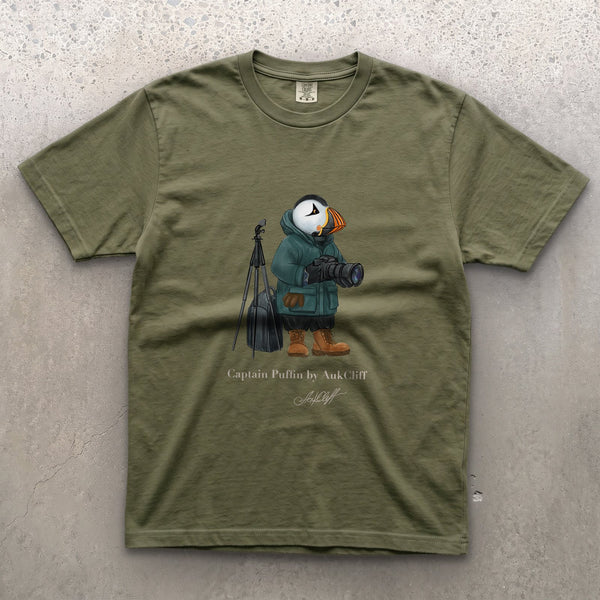
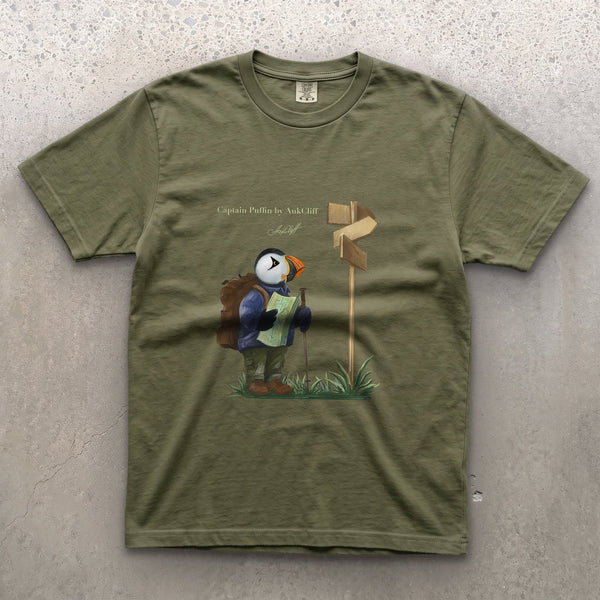
The Captain Puffin character series is hand drawn, and each Captain stands for a discipline within outdoor and wildlife culture. The Early Birder is the most contemplative of the three bird designs. He is not the bird photographer with the long lens. He is not the coastal birder with the scope. He is the puffin with a thermos at the kitchen window, watching the feeder before anyone else is up, and he is the bird who watches first.
The Captain Puffin Early Birder T-shirt is printed on midweight cotton, the natural mid-layer for a still-air dawn walk. The matching Captain Puffin Early Birder Sweatshirt is on a midweight 80/20 cotton-poly fleece with a softly brushed interior, roughly 290gsm (Cotton Heritage M2480 blank). Warm at rest, comfortable for the kitchen-window sit, quiet on the wrist of a binocular strap, and easy to walk home in once the sun is up.
The Early Birder Captain Puffin was drawn for the dawn chorus people in the AukCliff audience. The thread across all twelve Captains in the Crew series is the willingness to be out when most people are not. The Early Birder is the gentlest version of that thread. Four thirty alarm. Black coffee. Wait.
Frequently Asked Questions
What is the best base layer for sunrise birdwatching?
A 200gsm merino long sleeve is the standard answer for a UK or Irish May morning. Merino stays warm when damp, resists odour over multiple uses, and runs silent under binocular straps. Synthetic alternatives work but smell faster across consecutive mornings. Avoid cotton next to skin for the walk in because dew and sweat together turn it cold the moment you stop moving.
What time does the dawn chorus actually start in May?
In the UK and Ireland the dawn chorus begins in the half hour before sunrise and peaks in the twenty minutes around sunrise itself. On a still May morning that runs from roughly four thirty to six. The robin and blackbird usually open it. To hear the build you need to be in position by at least fifteen minutes before sunrise, which means leaving the house in the dark.
Do I need a red headlamp for dawn birding?
Yes for any walk in that takes you off a paved path. White light at four fifteen disturbs roosting birds and floods your own night vision. A red filter preserves both. Most modern headlamps from Petzl and Black Diamond include a red mode as standard. Use it for the walk in only, then switch off as soon as you sit.
Is a sweatshirt or a fleece better for the dawn chorus?
A midweight brushed cotton or cotton-poly sweatshirt is the better mid layer for a dawn walk. It is warm at rest, quiet on binocular straps and rucksack straps, and comfortable for the full three to four hours the walk often runs. Most polyester fleeces are warmer for the weight but louder against straps and harder to live in across the warm-up.
What should you carry hot in a flask for a four thirty start?
Black coffee, hot milk, or strong tea are the three answers most working bird survey volunteers give. A Stanley Classic vacuum flask holds heat for the four hours a dawn walk routinely becomes, and a Klean Kanteen TKPro is the quieter sibling for sensitive sites. Sugar and a small bar of dark chocolate help if the sit runs past two hours.
Shop the Early Birder Captain Puffin Sweatshirt or browse the full Captain Puffin collection for the other Captains in the Crew series.
Last updated: May 2026
Wear it out there
Simple
$75.99
Coastal Waves
$101.99
Captain Puffin Wildlife Photographer
$84.99
Captain Puffin Hiker
$84.99
Get the next one
New designs as they land, and the stories behind them. Unsubscribe in one click.